


Resumen
Esta investigación busca identificar los factores de éxito en proyectos latinoamericanos de Comercio Justo por medio de una revisión sistemática de literatura con el método Kitchenham y Charters. A partir de una extracción de datos y evaluación de los mismos a partir de literatura seleccionada determina de librerías en línea Scopus, Web of Science, Redalyc, Springer Link y Science Direct en el periodo 2018-2013, se determinó que los factores de éxito fueron apoyo gubernamental, incremento de producción, desarrollo y promoción de capacidades y alcance internacional de mercado. Además, identifica que estos dependen de factores complementarios relacionados con la capacidad de los productores y trabajadores de implementar certificaciones o prácticas de Comercio Justo en su producción, misma que es principalmente agrícola. Estos factores benefician a proyectos comunitarios de grupos vulnerables en áreas rurales, mientras se correlacionan a la exportación y los principios de Comercio Justo. Es decir, no necesitan de la certificación y pueden implementarse sus principios en una variedad de proyectos generando una serie de beneficios y limitaciones para su desarrollo.
Abstract
This investigation seeks to identify the success factors of Latin-American Fair Trade projects through a systematic literature review with the Kitchenham and Charters method. Through a data extraction and its evaluation from selected literature, to the online libraries Scopus, Web of Science, Redalyc, Springer Link and Science Direct in the range from 2018 to 2023 it determines that the success factors are government support, production increase, capacity building and skills promotion, and international market outreach. It also identifies that these factors depend on complementary factors related with the capacity of producers and workers to implement these Fair Trade certifications and practices in their production, mainly in agriculture. These factors benefit community-based projects from vulnerable groups in rural areas while correlating to exports and Fair-Trade principles. Meaning, certification is not compulsory, so its principles can be implemented in a variety projects, generating a series of benefits and limitations for their development.
Palabras clave
Derechos sociales y económicos, comercio internacional, condiciones de vida, relaciones Norte-Sur.
Keywords
International trade, North-South relations, living conditions, social and economic rights.
How to cite: Valdivieso-Albán, S. I., Tonon-Ordoñez, L., Bermeo-Arpi, A., & Acosta-Urigüen, M.-I. (2024). Desentrañando los factores de éxito de los proyectos de Comercio Justo en América Latina. DICERE Revista De Derecho Y Estudios Internacionales, 1(2), 132–149. https://doi.org/10.33324/dicere.v1i2.804
1 Introduction
Fair Trade, henceforth referred as FT, impacts the worldwide development of projects, improving the livelihoods of 965.700 workers and producers until 2018 (World Fair Trade Organization [WFTO], n.d.). Estimates determine that until 2020 at least 1.66 million FT producers and consumers, distributed in 1.500 projects, supplied Global North or GN (Williams, 2021). Furthermore, in 2022 FT shows a steep increase of capacity with 1.9 million workers and producers, organized in at least 1.930 cooperatives and associations, along 70 countries with more than 37.000 products, primarily agricultural (Fairtrade Ibérica, 2022). FT seeks to support international efforts to relief the 800 million people living under the poverty line (WFTO, 2018). Yet, regardless of the large-scale FT initiatives, these depend on GN Multinational Corporations or MNCs and retailers to reach market goals, weakening FT certification standards at the expense of sales promotion (Fridell et al., 2021).
FT model dates back to 1946 when the United States retailer Ten Thousand Villages started selling Puerto Rican textiles, so in 1958 the first official FT store that sold these fabrics and other goods was founded (WFTO, 2020). Initially, FT focused on Global South or GS handcarts sold in GN stores, so the first efforts to institutionalize it began in Europe with the European Fair-Trade Federation or EFTA in 1987 and the International Fair-Trade Association or IFAT in 1989 (Raynolds & Long, 2007).
The present research looks forward to determine the success factors of FT projects in Latin America. It aims to stablish the conditions that lead projects in the region to be successful producers and exporters to GN markets, abiding the FT requirements. This investigation pursues a systematic review of available literature applying the method of Kitchenham & Charters (2007). It gathers information about FT in the region from publications in scientific journals on relevant digital libraries with academic impact. The included literature undergoes a series of processes to assess its relevance and extract all relevant information.
2 Literature Review
International trade occurs when states or private companies exchange goods or services to gain profit with specialized or scaled up production, though sometimes it hinders society due to its effects on income distribution (Krugman et al., 2023). Similarly, international business is the trade of products and resources between nations within the global economic system (Bulatov, 2023).
FT proposes a system that protects and enhances common goods as a poverty alleviation pathway that enhances the access of small producers to the international market through fair supply chains with reasonable prices (WFTO, 2018). According to the WFTO (n.d.), FT is a trading association that uses dialogue, transparency and respect in order to generate markets, sustainable development, and safe trading conditions focused on marginalized producers in the GS. It requires of actors such as individuals, organizations and networks with the common goals of justice, equity and sustainable development (WFTO, 2018). FT is an alternative process, which improves producers’ lives due to their capacity to export their goods regardless of their limited resources (Redfern & Snedker, 2002), allowing the poorest producer and the richest consumer to use a cooperative market to fulfill each other’s needs (Mayo & Sahan, 2018).
The main business models within FT are social enterprises, cooperatives and associations. Social enterprises seek social objectives besides the traditional for-profit expectation; therefore, their environmental or social targets are legally binding and their revenues reinvested to fulfill their mission independently from governmental support. BCorp is a similar model to social enterprises, but it keeps the main purpose of gaining profits while implementing social commitments (Doherty et al., 2020). Cooperatives and associations are either groups of small producers or organizations of industrial employees or plantations’ workers (Organización de las Naciones Unidas para la Agricultura y la Alimentación [FAO], 2003), who apply democratic principles to make decisions, giving all members an equal vote despite their position as well as the possibility to create scale economies (Doherty et al., 2020).
FT’s main goal is to develop equal trade terms between MNCs and small producers beyond profit, such as equitable economy, democratic practices, international solidarity and social justice to advocate for better practices and more knowledgeable consumers (Williams, 2021). Since 2017, the WFTO proposes 10 principles that projects need to comply with in order to become FT Certified (WFTO, 2017). FT certifications and labelling harmonize standards across the globe so that all FT projects comply with identical guidelines to facilitate the categorization of FT in the international market and strengthen the trade capabilities of small producers (Carbaugh, 2019; Gerber, 2023).
FT proposes a system of prices able to cover production costs while granting Fairtrade premiums to the producers that can be re invested to fulfill their needs (Bulatov, 2023). The payment system in FT business models uses a minimum price complemented with Fairtrade Premiums linked to the sales’ volumes (Fairtrade International [FLO], 2023; Loconto et al., 2019). Premiums depend on the product type, region and local inflation (Fairtrade Foundation, 2023). These are meant to strengthen healthcare, education, communication resources and water management (Williams, 2021).
3 Material and Methods
A systematic literature review is a data gathering and processing method that uses the stages of Kitchenham and Charters (2007), planning, conducting and reporting the results. For the planning stage, a general research question is answered through sub-questions and the primary studies are extracted from digital libraries using a search string and an inclusion and exclusion criteria. Included works withstand a quality assessment to ensure their relevance to this research.
In the conducting stage, collected data is processed into a final set, which is quantitatively synthesized using bubble plots that outline the results’ most relevant category intersections. Finally, compiled results are compiled and complemented with qualitative analysis of the findings.
This systematic review aims to address the research question: what are the success factors for FT in Latin America? The expected result is to understand the success factors of FT initiatives in Latin America by answering the sub-questions:
RQ1 What is the advance of FT in Latin American projects?
RQ2 What is the success rate of Latin American FT certified projects?
RQ3 What is the state of the art on success factors related to FT in Latin American projects?
In order to answer the proposed research questions, the search string (“Fair trade”) AND (“Latin America”) AND (Success) was applied to the online libraries Scopus, Web of Science, Redalyc, Springer Link and Science Direct. Initially, the time frame to execute this systematic literature review was defined in the range from 2018 to 2023. However, due to the lack of enough results and its relevance, it was decided among the research group to perform the search from 2005 to 2023.
The initial search of this systematic review yielded one thousand sixty-six publications. After applying the inclusion and exclusion criteria, forty publications were studied in this investigation.
This review excludes introductory papers or those less than five pages long, books, chapters, workshops, duplicated works and papers in languages different from English or Spanish. Included publications present information about FT as a business success factor, successful enterprises in Latin America, the pros and cons of FT in Latin America, and accept Spanish due to its regional predominance for this research.
Included studies underwent a quality assessment with a questionnaire of subjective and objective questions, applying a three-point Likert-scale of +1 for very relevant studies, 0 for relevant studies, and -1 or for not relevant studies. The first question determined whether the paper addressed FT in Latin America or successful FT businesses. The second question assessed the relevance of the journals or conferences’ using the Scimago quartile-scale or the Latindex indexation, given its significance for publications in Spanish. Articles amongst the first and third quartiles scored +1, the fourth quartile or Latindex catalogue 0, and those with no quartile -1. The third question determined the relevance of the publications through the number of registered citations in Google Scholar. Publications with more than 5 citations scored 1, with less than 5 citations 0, and with no citations -1, preventing penalization of latest publications.
The data extraction employed a series of possible answers for each research sub-question as portrayed in the table below:
Table 1
Data extraction criteria
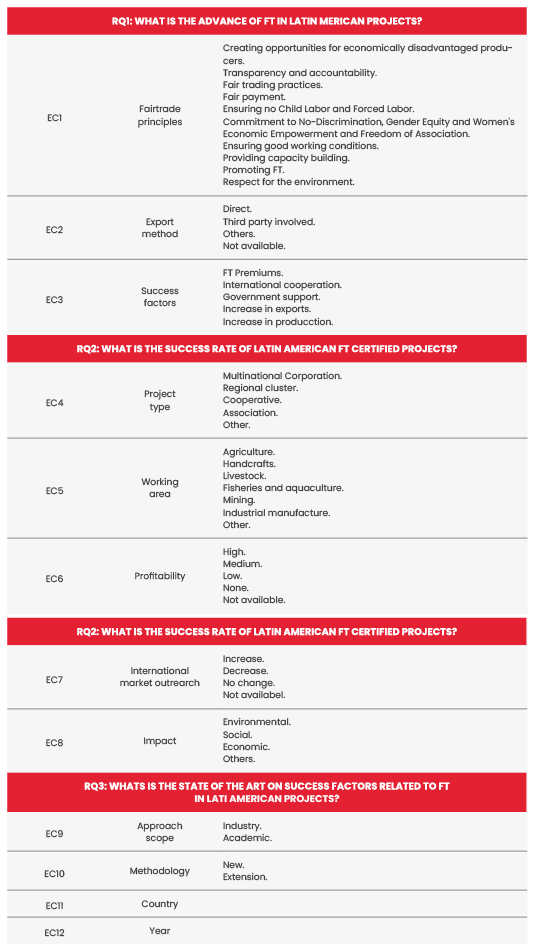
Source: based on Kitchenham y Charters, 2007
This review does not account for verification and validation techniques in its data extraction criteria, since these are not suitable techniques for social sciences research because they cannot be compared to real-world system behaviors or available data
is untraceable (Hahn, 2013).
4 Analysis and Results
Before discussing the literature’s specific research about the success factors for Latin American FT projects obtained in the results, this review assesses export methods and increase.
Available research of increase in exports as a success factor is limited. According to Botello & Guerrero (2014), the main factors to boost exports are technological advancements and working sector. Therefore, associations and cooperatives that apply traditional and ancestral production methods report lower exports (Enelow, 2015). Similarly, in a case study about orange production in Mercosur, market liberalization between Uruguay, Argentina and Brazil scarcely influenced export increase due to the limited liberalization, meaning that integration between countries did not contribute to capacity building because government cooperation and experience-exchange between producers were not mandatory (Ruffier, 2005). This implies that the success factor behind exports is actually capacity building, which in the same case study recalls the growing interest of producers to import Argentinian agrochemicals and other agricultural raw materials to improve production and reduce costs. Hence, capacity building and skills promotion needs international FT inputs and outputs.
According to a qualitative analysis of 10.000 Colombian enterprises, direct export capabilities are diminished by complex bureaucracy and phytosanitary certifications as well as high logistical costs that lead to export outsourcing mechanisms (Botello & Guerrero, 2014). Similarly, a case study of Colombian Small and Medium Enterprises or SME, determined that product adaptation facilitated exportation along with quality control policies in their production chains (Hoyos-Villa, 2019). FT businesses should upgrade industrial facilities and management guidelines to promote exports and international market outreach, which will generate economic impact through higher labor demand and economic development in the national level (Botello & Guerrero, 2014). This means that research up to this review links success with international market outreach and capacity building rather than with increase in exports. Nevertheless, Hoyos-Villa (2019) mentioned that, while 83% of Colombian coffee exporter SMEs implemented strategies to reduce distribution costs in previously penetrated international markets and have access to information about new potential international markets, only 58% them developed price strategies and 50% used product development strategies to access new markets. Likewise, Gudynas (2008) studied the case of the top Argentinian soy producer whose demand increased while affecting rural lifestyles and increasing its profits at the mercy of small producers who can only use agriculture as a survival strategy and depend on government aid or FT models to access international markets. Therefore, available research determined that increase in exports actually translates into international market outreach with its benefits.
As explained before, due to the impact of international market outreach, available literature considers it a success factor with the benefit of exports increase. Even though, a study about Brazilian companies suggests that a higher international market outreach generates negative financial results in comparison to companies focused on the national market, losses originate in resources mismanagement caused by internationalization rather than market outreach per se (Penido et al., 2010). Then, international market alone does not generate success in regional FT projects because complementary success factors such as international cooperation are required.
Again, Penido et al. (2014), use international market outreach and exports increase as interchangeable success factors when explaining how projects with higher indicators of international market penetration and exports have managed to cover costs and overcome the financial risks involved in exportation and market penetration. Similarly, Botello & Guerrero (2014) concluded that project internationalization requires technological improvements, lowers market penetration costs, legal certainty, financing and base line external factors like geographical location and working area, to generate significant international market outreach and exports.
Also, there are related success factor to international market outreach related to raw materials cost reduction for agricultural projects, which also benefited the project with higher profits and more competitive prices (Peñaloza et al., 2016). Moreover, international market outreach generating success in FT projects, require specialized production chains with higher production capacity, fair prices and fair income distribution in order to strengthen the project and improve life quality of its producers (Donovan & Poole, 2014; Vagneron et al., 2009).
FT allows producers to invest in larger and more technical agricultural projects, increasing their production (Hudson & Hudson, 2015). Yet, this success factor is not exclusive for FT certified projects, but rather as a factor required for any project with FT traits and principles. For example, the Chilean wine production association of small producers, Wine of Chile, clusters the production chain and vineyards in a single facility in order to standardize production practices, control quality and directly distribute the final product; this association’s wine is origin certified, benefiting from European Union international cooperation funding and investment (Zamora & Bravo, 2005). Therefore, increase in production is a success factor for FT initiatives even if these are not certified and only apply FT principles or have similar business models.
However, a case study about FT Mexican coffee producers determined that production costs caused by organic production or expensive labor due to immigration in FT certified projects is higher than in regular businesses, so fair prices are unable to cover production costs and generate significant revenues (Hudson & Hudson, 2015). The only scenario in which this trend shifts is when international price crises generate loses in regular producers without affecting FT producers because of the minimum price (Beuchelt & Zeller, 2011). Nevertheless, a study about organic FT coffee production in Nicaragua suggests FT production is 50% below the national average production and only exclusively organic producers register significant revenues due to the limitations of the FT certification (Beuchelt & Zeller, 2011). Thus, costs allow uncertified FT cooperatives or associations to become successful by complying to FT principles without certification. Conversely, Enelow (2015) mentioned that FT cooperatives and associations report high revenues with long term success and high economic impact when producers apply community-based production practices, perform family farming or use ancestral production methods and systems instead of hired labor. Even though, the Nicaraguan coffee producing FT cooperative, Soppexcca, facilitates the access to supply chains and marketing due to their hired labor, this factor does not improve production or diversifies it (Donovan & Poole, 2014).
Conversely, Brazilian traditional enterprises have been able to diversify its business with new services through the development of effective and highly profitable marketing strategies (Schuh & Díez-Vial, 2009). This implies that production increase has the potential to diversify it and increase revenues (Philpott et al., 2007). A case study of the Mexican fishing cooperative, Punta Allen, indicated that this project diversified its main productive activity, lobster fishing, with tourism services, communitarian financial services, and an environmental impact biodiversity inventory program (Méndez-Medina et al., 2015). Another example of successful production increase are the Bolivian Brazilian nut producers that became the world’s main producers thanks to their cooperative efforts to improve production facilities and ensure their production fulfilled European export standards (Coslovsky, 2014). Similarly, in 2005 Argentina’s orange production doubled in comparison to Uruguay due to the creation of an export association to abide international quality standards (Ruffier, 2005). This suggests that profitable and successful production increase requires effective management of exports and international quality standards. The only exception are social enterprises. The waste management initiative of the Environmental Management Committee created by the Peruvian association Cerro del Pino, that applied Social and Solidarity Economy initiatives for social and cultural impact, cooperated with local NGOs to obtain volunteer work and funding and hired paid workers to generate economic, social and environmental impacts (Tello-Rozas, 2016).
Hired labor force and quality improvement in successful production chains stablish the importance of skills promotion and capacity building. For example, Mexican industrial clusters reported that geographical location, culture, management and skills promotion influenced the success rate and increased competitivity (Jiménez et al., 2013). Yet, FT certified projects also benefit from skills promotion, as coffee-producing cooperatives and associations in Central America benefited from the skills and productivity of their women producers, who then benefit from having decision-making roles, fair wages and access to private property (Lyon et al., 2010). Also, Altieri & Nicholls (2008) recognized that FT projects require investment and research about agriculture to improve their productive processes and guarantee food sovereignty for Latin America. Thus, the FT principle of gender inclusion and women empowerment boosts the success factor of skills promotion and capacity building and is affected by production increase and government support.
A social project included small producers in the Brazilian biodiesels production chain, generating strong social and economic impact in the producers due to the government’s skill promotion and capacity building programs (Stattman & Mol, 2014), which implies government support is liked with skills promotion and capacity building. Yet, a study about Venezuelan SMEs concluded that business owners with university education and market experience developed technical policies and effective management strategies in their businesses, generating economic impact and new jobs that improve their communities’ living conditions (Peñaloza et al., 2016). As a result, FT workers and producers fall short of education and experience. Therefore, skills promotion and capacity building fulfill the FT principle of creating opportunities and providing financial stability to vulnerable producers.
In sync with this success factor, Research and Development or R&D in the agricultural sector allows producers to use implement findings in similar territories or crops instead of repeating research, which facilitates strategic information flow of international market outreach studies, technical guidelines, disease prevention methods, and financial sustainability studies (Ruffier, 2005). Nonetheless, a similar study in Colombia compared national companies and MNCs ability to access innovation and R&D, finding that MNCs are more likely to become successful when using it unless both projects specialize in exports, in which case innovation and R&D had similar effects (Albis & Álvarez, 2017). Lastly, research about the Mexican fishing cooperative, Punta Allen, acknowledged that the cooperative became successful and influential in the region after updating its fishing gear and complying with a complex legal framework through effective legal advising and NGO cooperation; hence, improving the products’ quality and increasing profits (Méndez-Medina et al., 2015). Literature suggests that skills promotion and capacity building is a success factor for any business model, but when applied correctly has large benefits for FT cooperatives and associations along with government support.
Provided that government support is a business success factor, the Bolivian government support program managed to adapt Brazilian nut producers to new export requirement from the EU with national legislation to monitor the percentage of banned substances present in the product before leaving Bolivia (Coslovsky, 2014). Likewise, in 2019, after the Colombian peace agreement with the paramilitary groups, new investment opportunities allowed former terrorists to participate in successful agricultural projects and export their products such as agrofuels or monocultures because government support improved their life quality (Ramírez et al., 2019). Conversely, a similar strategy of the Brazilian government’s program to include small producers’ cooperatives in the biodiesel production chain using a preferences system that endorses the participation of these small producers, hindered their strategies to penetrate new markets (Stattman & Mol, 2014).
Financing is an element of government support for any project. López-Rodríguez et al. (2021) mentioned the importance of credit line facilitation and strategies to encourage investments as success factors for Colombian initiatives. Likewise, Fontalvo-Hererra et al. (2019), determined that SMEs benefited from easy-access credit lines in the Colombian Bank of Foreign Trade to penetrate international markets like China, Europe and South America. Lastly, an investigation about Costa Rican pineapple production recognized that GN investments in Latin America boosted agricultural production, especially in Ecuador, Honduras and Guatemala, but these countries continue to be small suppliers and MNCs benefit more due to the know-how obtained from the investment-receiving projects to develop large monocultures with high quality standards and higher exports, which smaller producers cannot comply with (Vagneron et al., 2009).
Considering the importance of financing in government support, fair prices and FT premiums also have a strong relationship with it. FT sets a minimum price that limits the producers’ ability to control consumer prices in their GN markets, regardless of higher revenues, they have limited price control and market adaptability (Kilian et al., 2006). Moreover, fair prices, though higher than the market’s average, are only beneficial for producers during international price downfalls (Beuchelt & Zeller, 2011), otherwise these prices cannot cover production costs and only support improvements in the production chain when reinvested and may generate long term revenue increase (Philpott et al., 2007). Low minimum prices hardly benefit producers and fail to address basic FT goals like poverty alleviation and better living conditions, increasing poverty in some cases (Beuchelt & Zeller, 2011). For example, in the early 2000s the minimum FT coffee price was only 4,13% above the average market price (Tadros & Malo, 2003). However, Fairtrade premiums allow producers to overcome these international price drops (Donovan & Poole, 2014).
Even though Enelow (2015) discussed the ability of FT premiums to strengthen the projects’ capabilities and increase their success rate, Bruce (2016) concluded that the real benefit of premiums is to improve skills promotion, capacity building, and provide new funding opportunities. According to Kilian et al. (2006), organic coffee sales from Central America to Europe generated higher profits than FT certified coffee because price depends on quality as an aggregated value, so FT producers may have a single long term buyer, stagnating prices and yielding poor financial results. Nevertheless, Hudson & Hudson (2015) recognized that producers can guarantee their land ownership due to the stable pricing in the FT system. Additionally, women inclusion in FT projects, such as the coffee producing Latin American Organic FT Association, allowed them to sell their products at fairer prices and become more independent because they can monitor sales to get fair payments (Lyon et al., 2010). In general, any project in a vulnerable group or community, such as the successful decent housing initiative of a Brazilian construction company that created positive seller-buyer relationships with fair housing prices (Morais-da-Silva et al., 2020).
FT integrates within communitarian dynamics so as to spread principles like fair price or sustainable trade relationships with the GN to encourage community support and productivity among community leaders (Lemay, 2007). In fact, for Guatemalan coffee producers, FT created a consumer market in favor of local development with social and economic impact in tune with cultural systems and Human Rights’ promotion such as gender inclusion (Lyon, 2007), regardless of the diverse approaches indigenous communities have towards the FT system (Lemay, 2007). FT generates win-win negotiations between buyers and producers (Lyon, 2007), following FLO trading guidelines to benefit communities (Lemay, 2007).
5 Discussion and Conclusions
Skills promotion and capacity building strengthen the projects’ organizational structures because producers and workers acquire technical capabilities to make informed decisions and perform professional planning. Thus, increasing exports and international market outreach. Furthermore, successful projects strengthen their production chains with aboriginal techniques to reach new international markets and comply with international quality standards that satisfy the GN demand and revaluate rural cultures in the GS. Therefore, associations and cooperatives need to evaluate their strengths and weaknesses to apply FT.
Government support stimulates the development of FT projects with reliable legal frameworks and social programs to promote their capabilities along with NGOs and local advisors. Additionally, they report that clear financing guidelines are a complementary factor that provides easy access to credits, international cooperation funds, and financial costs reduction. Consequently, financing is a prospect study subject.
For projects to offer better quality products and increase their production, workers need to be knowledgeable about international trade and the FT prices and premiums system, increasing international market outreach. Hence, they can match MNCs negotiation level to demand fair prices and market participation to develop direct relationships consumers through FT specialized stores.
This systematic review accomplished its objective identifying skills promotion and capacity building, increase in production, increase of international market outreach, and government support as the four main FT success factors.
Successful FT projects in the region consist of preexisting social and organizational structures where producers and workers have decision-making power. Consequently, the organizational systems of historically vulnerable communities with FT projects are solid and productive in comparison to those of cooperatives and associations without them, benefiting from poverty reduction, better living conditions, environmental conservation, social inclusion, and fair payments. Also, these FT cooperatives and associations have stable revenue streams throughout the year and can endure economic crises or unexpected price downfalls.
FT diverges from the goals and objectives of traditional business models because its projects seek to use their revenue to improve community living conditions. Additionally, FT projects apply horizontal decision-making models with equal vote rights. However, FT projects revenue form minimum prices and premiums is either reinvested in skills promotion and capacity building or does not cover production costs, hindering initiatives to improve living conditions, so growth and sales strategies are necessary.
GS government trade and economy agencies or regional entities may use this research to develop policies or programs that benefit and promote FT initiatives in their territories. Similarly, investors and businesses can better comprehend and apply alternative models or success factors to their projects, especially if these are new FT projects in rural areas.
FT research in Latin America is limited since the earliest publication about the region dates back to 1996, excluding important evaluation of data from previous decades. Another limitation is language as Portuguese was excluded despite of the importance of Brazil as an international trade hub, only two publications from this country were analyzed in this review. Also, future reviews should include more libraries besides the open access and paid libraries that were available to conduct this research.
This review supports future FT investigations because it compiles outstanding research. Future reviews should focus on each success factor separately to comprehend its influence in FT compared to traditional projects. Likewise, the benefits and risks of FT should be further evaluated. This investigation could be replicated in other GS regions such as Africa, South-east Asia, the Pacific and Eastern Europe.
CRediT authorship contribution statement:
Sebastián Valdivieso: Formal análisis, Investigation, Writing – original draft.
Luis Tonon: Conceptualization, Investigation, Supervision, Writing – review and editing.
Alexandra Bermeo: Methodology, Validation, Writing – review and editing.
Inés Acosta: Methodology: Validation, Writing – review and editing.
Declaration of competing interest:
The authors have no competing interests to declare.
Referencias Bibliográficas
Albis, N., & Álvarez, I. (2017). A comparative analysis of the innovation performance between foreign subsidiaries and owned domestic firms in Colombian manufacturing sector. Journal of Globalization, Competitiveness & Governability, 11(2), 20–41. https://doi.org/10.3232/GCG.2017.V11.N2.01
Altieri, M., & Nicholls, C. (2008). Scaling up agroecological approaches for food sovereignty in Latin America. Development, 51(4), 472–480. https://doi.org/10.1057/dev.2008.68
Beuchelt, T., & Zeller, M. (2011). Profits and poverty: Certification’s troubled link for Nicaragua’s organic and fairtrade coffee producers. Ecological Economics, 70, 1316–1324. https://doi.org/10.1016/j.ecolecon.2011.01.005
Botello, H., & Guerrero, I. (2014). Condiciones y determinantes de la internacionalización de las empresas industriales colombianas: una aproximación cuantitativa en el ámbito de la firma. Revista Apuntes del CENES, 33(57), 257–286
Bruce, A. (2016). The Legacy of Agrarian Reform in Latin America: Foundations of the Fair Trade Cooperative System. Geography Compass, 10(12), 485–498. https://doi.org/10.1111/gec3.12298
Bulatov, A. (2023). World Economy and International Business.
Carbaugh, R. (2019). International economics (7th ed.).
Coslovsky, S. (2014). Economic development without pre-Requisites: how Bolivian producers met strict food safety standards and dominated the global brazil-nut market. World Development, 54, 32–45. https://doi.org/10.1016/j.worlddev.2013.07.012
Doherty, B., Haugh, E., Sahan, E., Wills, T., & Croft, S. (2020). Creando la Nueva Economía. 1–48. https://wfto.com/sites/default/files/Business_Models_Report%20-%20Spanish_z.pdf
Donovan, J., & Poole, N. (2014). Changing asset endowments and smallholder participation in higher value markets: Evidence from certified coffee producers in Nicaragua. Food Policy, 44, 1–13. https://doi.org/10.1016/j.foodpol.2013.09.010
Enelow, N. (2015). Coffee, cooperatives, and choba-choba: the role of non-market labor networks in building equitable supply chains. Eutopía - Revista de Desarrollo Económico Territorial, 7, 39–55. https://doi.org/10.17141/eutopia.7.2015.1658
Fairtrade Foundation. (2023). Fairtrade Premium. https://www.fairtrade.org.uk/what-is-fairtrade/what-fairtrade-does/fairtrade-premium/
Fairtrade Ibérica. (2022). El impacto de Fairtrade. https://www.fairtrade.es/impacto/
Fairtrade International. (2023). Fairtrade Minimum Price and Faitrade Premium Table (pp. 1–65). http://www.fairtrade.net/our-standards.html.
Fontalvo-Hererra, T., Morelos-Gómez, J., & Olivos-Aarón, S. (2019). Efficiency of midsize enterprises in the free-trade-zone in Barranquilla – Colombia. Entramado, 15(2), 12–26. https://doi.org/10.18041/1900-3803/entramado.2.5476
Fridell, M., Hudson, I., & Hudson, M. (2021). The tensions, contradictions and challenges in the search for Fair Trade. The Fair Trade Handbook.
Gerber, J. (2023). International economics (8th ed.).
Gudynas, E. (2008). The new bonfire of vanities: Soybean cultivation and globalization in South America. Development, 51(4), 512–518. https://doi.org/10.1057/dev.2008.55
Hahn, H. (2013). The conundrum of verification and validation of social science-based models. Procedia Computer Science, 16, 878–887. https://doi.org/10.1016/J.PROCS.2013.01.092
Hoyos-Villa, O. (2019). Factores que impulsan la internacionalización en las pymes industriales del Eje Cafetero colombiano: estudio de caso. Entramado, 15(2), 78–103. https://doi.org/10.18041/1900-3803/entramado.2.5597
Hudson, I., & Hudson, M. (2015). Una crítica vacilante: cómo el potencial del Comercio Justo disminuye con “éxito.” Eutopía - Revista de Desarrollo Económico Territorial, 7, 131. https://doi.org/10.17141/eutopia.7.2015.1793
Jiménez, K., Medina, J., & Cheín, N. (2013). Economía: Teoría y práctica Universidad Autónoma Metropolitana Unidad. Economía: Teoría y Práctica, 39, 89–117. http://www.redalyc.org/articulo.oa?id=281130720005
Kilian, B., Jones, C., Pratt, L., & Villalobos, A. (2006). Is sustainable agriculture a viable strategy to improve farm income in Central America? A case study on coffee. Journal of Business Research, 59(3), 322–330. https://doi.org/10.1016/j.jbusres.2005.09.015
Kitchenham, B., & Charters, S. (2007). Guidelines for performing Systematic Literature Reviews in Software Engineering. EBSE Technical Report, 1–57. https://www.elsevier.com/__data/promis_misc/525444systematicreviewsguide.pdf
Krugman, P., Obstfeld, M., & Melitz, M. (2023). International economics theory & policy (12th ed.).
Lemay, J. (2007). Cartografía de un proyecto de comercio justo en el Sur: la Central Interregional de Artesanos de Perú. Cayapa. Revista Venezolana de Economía Social, 7(14), 37–53.
Loconto, A., Silva-Castaneda, L., Arnold, N., Jimenez, A., & Participatory, A. (2019). Participatory Analysis of the Use and Impact of the Fairtrade Premium. https://hal.science/hal-02048855
López-Rodríguez, C., Moscoso-Aldana, R., Ávila-Ávila, C., & Ibarra-Nieves, J. (2021). Internacionalización de empresas comercializadoras de servicios de alojamiento y comida en Colombia: determinantes para el éxito comercial. Revista Economía y Política, 34, 57–72. https://www.redalyc.org/articulo.oa?id=571167877006
Lyon, S. (2007). Fair trade coffee and human rights in Guatemala. Journal of Consumer Policy, 30, 241–261. https://doi.org/10.1007/s10603-007-9040-7
Lyon, S., Aranda, J., & Mutersbaugh, T. (2010). Gender equity in fairtrade-organic coffee producer organizations: Cases from Mesoamerica. Geoforum, 41(1), 93–103. https://doi.org/10.1016/j.geoforum.2009.04.006
Mayo, E., & Sahan, E. (2018). Can we have a Fair Trade economy? Coop News. https://www.thenews.coop/128538/topic/fairtrade/can-fairtrade-economy/
Méndez-Medina, C., Schmook, B., & McCandless, S. (2015). The Punta Allen cooperative as an emblematic example of a sustainable small-scale fishery in the Mexican Caribbean. Maritime Studies, 14(12), 1–19. https://doi.org/10.1186/s40152-015-0026-9
Morais-da-Silva, R., Segatto, A., & Bezerra-de-Sousa, I. (2020). Connecting two sides: a qualitative study on social innovation ventures and poor communities in an emerging economy. Voluntas, 31(5), 966–980. https://doi.org/10.1007/s11266-019-00156-x
Organización de las Naciones Unidas para la Agricultura y la Alimentación. (2003). Guía Práctica sobre por qué, cómo y con Quién Certificar Productos Agrícolas para la Exportación. https://www.fao.org/3/ad818s/ad818s03.htm
Peñaloza, M., Ramírez, D., & Barrios, M. (2016). Factores de permanencia y éxito competitivo en la PyMI del municipio Libertador de Mérida, Venezuela. Economía, 41(41), 151–171.
Penido, E., Cyrino, Á., de Miranda, M., & Leme, M. (2010). Does internationalization pay off? A study of the perceived benefits and financial performance of the international operations of Brazilian companies. Journal of Globalization, Competitiveness & Governability, 4(3), 38–61. https://doi.org/10.3232/gcg.2010.v4.n3.03
Philpott, S., Bichier, P., Rice, R., & Greenberg, R. (2007). Field-testing ecological and economic benefits of coffee certification programs. Conservation Biology, 21(4), 975–985. https://doi.org/10.1111/j.1523-1739.2007.00728.x
Ramírez, N., Monroy, S., & Guevara, D. (2019). Agroecology and integral microfinance: recommendations for the Colombian post-conflict avoiding the financialization of rural financing. Cuadernos de Economía, 38(78), 729–751. https://doi.org/10.15446/cuad.econ.v38n78.73236
Raynolds, L., & Long, M. (2007). Fair Trade: The Challenges of Transforming Globalization (pp. 15–32).
Redfern, A., & Snedker, P. (2002). Creating Market Opportunities for Small Enterprises: Experiences of the Fair Trade Movement. In Organización Internacional del Trabajo (30). https://www.ilo.org/wcmsp5/groups/public/---ed_emp/---emp_ent/---ifp_seed/documents/publication/wcms_117707.pdf
Ruffier, J. (2005). La frontera como ventaja competitiva: la producción de naranjas en ambas márgenes del río Uruguay. Revista Galega de Economía, 14(2), 1–20.
Schuh, A., & Díez-Vial, I. (2009). La diversificación en las empresas de medios: El caso de Globo en Brasil. Journal of Globalization, Competitiveness & Governability, 3(3), 90–105. https://doi.org/10.3232/GCG.2009
Stattman, S., & Mol, A. (2014). Social sustainability of Brazilian biodiesel: The role of agricultural cooperatives. Geoforum, 54, 282–294. https://doi.org/10.1016/j.geoforum.2014.04.001
Tadros, C., & Malo, M. (2003). Comercio equitativo del café: Equal Exchange, un modelo cooperativo de solidaridad. Cayapa. Revista Venezolana de Economía Social, 3(6), 7–22.
Tello-Rozas, S. (2016). Inclusive innovations through social and solidarity economy initiatives: a process analysis of a Peruvian case study. Voluntas, 27(1), 61–85. https://doi.org/10.1007/s11266-015-9606-y
Vagneron, I., Faure, G., & Loeillet, D. (2009). Is there a pilot in the chain? Identifying the key drivers of change in the fresh pineapple sector. Food Policy, 34(5), 437–446. https://doi.org/10.1016/j.foodpol.2009.05.001
Williams, J. (2021). Fair Trade, firsthand: connecting Northern consumers with Southern producers. In G. Fridell, Z. Gross, & S. McHugh (Eds.), The Fair Trade Handbook.
World Fair Trade Organization. (2017). Resolution Document 2: 10 Principles of Fair Trade.
World Fair Trade Organization. (n.d.). About World Fair Trade Organization. World Fair Trade Organization. Retrieved October 5, 2022, from https://wfto.com/who-we-are#our-grassroots-history
World Fair Trade Organization. (2018). International Fair Trade Charter. https://www.fair-trade.website/the-charter-1
World Fair Trade Organization. (2020). History of Fair Trade. https://wfto.com/about-us/history-wfto/history-fair-trade
Zamora, J., & Bravo, M. (2005). Wine, product differentiation and tourism: exploring the case of Chile and the Maule region. Universum. Revista de Humanidades y Ciencias Sociales, 2(20), 298–315